
Airports are varied places in size, location and the type of destinations they serve. For this reason, nobody responsible for sourcing the washroom furniture should take a one-size-fits-all approach to the task.
A recent BBC Bitesize feature highlighted just how diverse airports can get. Far from the huge, multi-terminal big city hubs with large planes carrying passengers by the hundreds to a myriad of international destinations, others can be very small and remote.
Examples it gave included:
- Barra in the Outer Hebrides, a tiny airport that uses the tidal beach as a runway and receives just two flights a day.
- Longyearbyen on Svalbard, serving the world’s northernmost town and using a permafrost surface as a runway.
- By contrast, the feature noted that King Fahd Airport in Saudi Arabia is the world’s largest by surface area.
- Perhaps the most spectacular is Changi Airport in Singapore, which includes the
largest indoor waterfall in the world.
That is not the only thing that Changi is renowned for. Widely regarded as one of the best airports in the world, with Skytrax recently listing it as number one for the second successive year, it is more than just a gateway to the famous city-state.
Can You Get A Shower At The World’s Best Airport?
For many travellers, it is a key stopping point between flights spanning half the globe, such as long-haul journeys between Europe and Australia, or other Asian destinations. This means many people will arrive needing more than just basic facilities.
Elements like a spa and a movie theatre are evidence that this is no ordinary airport, but there is more to Changi than just washrooms with sinks. It has its own showering facilities.
This makes obvious sense, for many will reach the airport feeling tired after a long flight, often a bit sweaty and certainly in need of some freshening up. A lovely shower could be just what they need before they spend several more hours on board another plane.
To provide such facilities means investing in items you might not normally think of, such as commercial shower curtains. These will be used regularly, especially in a busy hub like Changi, where they are enjoyed by passengers on a pay-per-use basis.
However, it is important to calibrate the furnishings and equipment you are investing in with the characteristics of the airport. In a case like Changi, where so many will be stopping for a few hours between long-haul flights, the need for showers and other facilities is obvious.
In addition, the volume and location of washroom facilities will also be important. This will help you to deal with the number of passengers who will need to use them, as well as the fact that in a large airport, they will need to be spread out to serve different areas.
Where Are The Best Places For Airport Washrooms To Be Located?
An ideal approach would be to place them in locations where they will be needed at their most urgent, as well as periodically by those waiting for flights. Examples could include:
- In areas close to boarding gates, so that passengers can go before they board their flight and are not left sitting uncomfortably cross-legged during take-off.
- Near to food and drink outlets
- Close to transport hubs, for example a bus, rail or metro station serving the airport.
Location is a more acute issue in a large airport than in a small one. Bara does not need large facilities and with two small planes landing a day, there won’t be much of a queue for the loo, which comes with a café in the terminal, redeveloped in 2022-23.
The situation will be somewhat different in Glasgow, which provides the connection to Barra, as it is much larger. However, any airport will need to make sure it has facilities for all airport users.
Should All Airports Have Accessible Facilities?
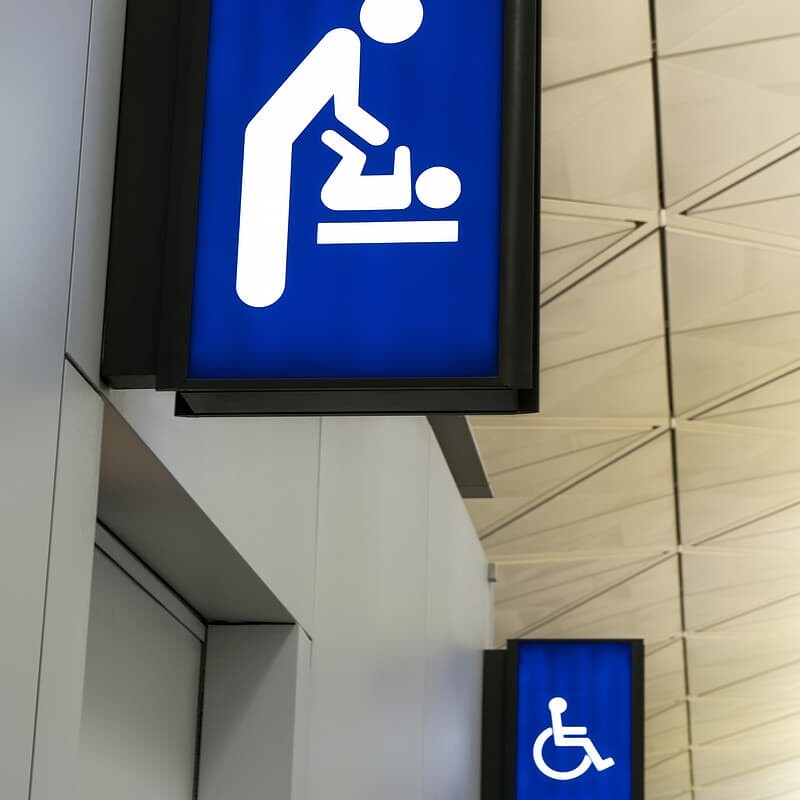
A good example of this is the need to ensure there are disabled toilets, which in Glasgow’s case are embedded in the dedicated ‘Changing Places’ facility for those with mobility issues. Barra also has accessible washrooms, showing that no airport is too small to have them.
Naturally, nobody would go so far as to suggest that Barra has shower facilities added, since it has no long-haul services. However, that is a worthwhile consideration for major international airports, especially those undergoing enlargement.
Gatwick may be a case in point. The airport has just overcome the final legal challenge to its planned second runway, enabling construction to start soon.
That means there will be 100,000 extra flights a year from 2030 and, to accommodate the extra passengers, the project will involve terminal expansions.
At present, the chance to have a shower at Gatwick is tied in with wider ‘arrive and refresh’ packages involving private rooms that may be more than the average traveller would want to pay. But this may change as plans for the expanded terminals take shape.
Similarly, Heathrow has shower facilities in Terminals 2,3,4 and 5, but all of these are located in departure lounges with additional fees involved.
Therefore, it is certainly possible to shower and freshen up there, but not every passenger will have the access they would get at Changi.
Heathrow does, however, take a very expansive view of general washroom facilities, taking into account a range of needs and wishes:
- Accessible toilets, sometimes as single unisex facilities, or sometimes embedded in men’s or women’s washrooms
- Inclusive facilities for those with hidden disabilities
- Washrooms for those of all gender identities who would be more comfortable using those over gender-specific facilities
How Can Airports Meet The Washroom Needs Of All Users?
This diverse provision acknowledges that in a large airport transporting millions of people a year to all sorts of destinations around the globe, there will be a very wide demographic variation in users.
Just as the demographics of airport users vary, so do the airports themselves. Their different sizes, locations and the flights that take off and land there will shape the facilities that are needed.
All airports will need washrooms, but not all will need shower facilities. However, when the latter is something that many will make use of, the next decision is whether to make them part of exclusive offerings for those using executive or VIP lounges, or open to all.
Related Posts