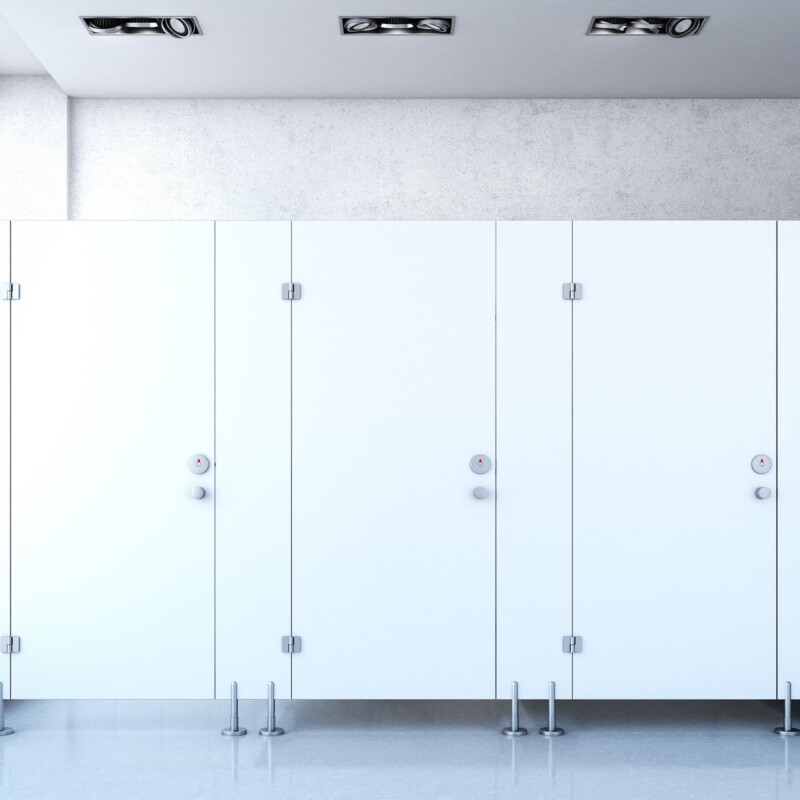

They are such a common design feature that chances are you barely register that many public toilet cubicles feature gaps between the floor and the doors, as well as the partitions between the stalls.
But you may also be wondering why these gaps are part of commercial toilet cubicle design. Of course, having a gap allows you to see when a toilet stall is occupied, versus when a door may be closed but there is no one using the stall.
While this is handy for those making use of public washrooms, there are several other, more important reasons, for the gaps at the bottom of toilet cubicles. These are:
- Hygiene
- Ease of cleaning
- Air circulation
- Emergency access
- Cost
Let’s look at each in turn.
1. Hygiene
We all know why we use public washrooms and it’s little surprise that they can harbour a range of germs. Interestingly, one study found that the locations in public washrooms with the highest number of bacteria were the countertops, the floor and the toilet flush handle.
It is little surprise that the floor is one of the dirtiest areas in a public washroom given the number of people who use it each day. But this is also one of the reasons why toilet cubicles have a gap underneath them: to improve hygiene in washrooms.
This is because there are fewer edges where dirt, grime and bacteria can build up when there are gaps under the partitions and doors between the stalls. Which brings us onto our next point.
2. Ease of cleaning
Closely linked to hygiene as the reason for the gaps under toilet cubicle doors is ease of cleaning. Not only do these gaps give bacteria and dirt fewer places to collect, but they also make it much easier to clean the floor of the washroom.
This is because cleaning staff can easily get a mop underneath the doors and partitions to clean every part of the floor thoroughly.
These gaps also make it much easier for cleaning staff to see if any of the toilet cubicles are in need of some extra attention too, either because of water on the floor or because people have dropped toilet paper that needs to be removed.
Some washrooms also feature subtly sloping floors that allow any excess water to run into a drain. Naturally, this only works if there are no barriers to the liquid, which is another argument for choosing cubicle doors and partitions that have gaps.
This ensures that any water that gets splashed on the floor runs towards the drain naturally, while also being easy to move in that direction using a mop or squeegee.
3. Air circulation
We can all understand why public washrooms might get smelly, but the cubicles themselves will develop a less overpowering odour if there are gaps beneath the partitions and doors.
This is because these gaps enable air to flow more freely in the space, which in turn means that unpleasant odours don’t get trapped in individual toilet cubicles. One study found that ventilation is important for general hygiene in public washrooms as well.
The study concluded that improving ventilation on public toilets would reduce the spread of bacteria and therefore make them more hygienic locations.
While the gaps under cubicle doors and partitions won’t automatically improve ventilation of the whole room, it will help the air to circulate more effectively, which could be valuable when paired with an extractor fan or similar.
4. Emergency access
This is hopefully a reason for the gap that you’ll never need to experience for yourself. If there is a space under the door, it is much easier to see if the occupant in the cubicle has experienced a medical emergency.
What’s more, the gaps both below and above the cubicle partitions make it easier for emergency services personnel to gain access to someone who needs their help.
5. Cost
This is primarily the concern of the organisation installing new cubicles in its washrooms, but it’s an important factor to bear in mind. Material costs within the construction industry have risen considerably in recent years and many professionals expect that trend to continue.
As a result, selecting products that require fewer raw materials in their production is a sensible way to reduce the expense of replacing washroom partitions, or of fitting new ones in a building, without compromising on quality.
Given that so many of us expect there to be gaps under cubicle doors and partitions, it is also not a negative design feature in this context. On the contrary, as we have seen this kind of cubicle design has many positive aspects to it.
Related Posts