
While various materials can be used for public washroom fittings, one of the most commonly used materials is stainless steel, and with good reason. In fact, stainless steel has some excellent qualities that make it a natural choice for washrooms that are open to the public.
These qualities include:
- Its durability
- Its resistance to corrosion
- Its non-porous surface
- Its sleek appearance
- Its sustainability
Let’s look at each of these qualities in turn and explore why this makes stainless steel a top choice for a range of fixtures in a public washroom.
Stainless steel’s durability
Public washrooms can undergo heavy use in some locations and when you set up these kinds of facilities you want to know that they will serve the community for the long term. Steel is strong and resistant to impacts.
This makes it harder for your fixtures to be damaged by vandals. It is also resistant to staining (as its name suggests), which means that graffiti is also less likely to last on a stainless steel feature than on another material like ceramics, for instance.
While vandalism is not your only concern when you open a new public toilet, rates of criminal damage in the UK have remained broadly steady for 20 years. This means you can’t discount the possibility of someone defacing your public washroom once it is open.
Stainless steel fittings make this less likely, while also making it easier to remove graffiti because steel is a shiny surface that is easy to clean.
Stainless steel’s resistance to corrosion
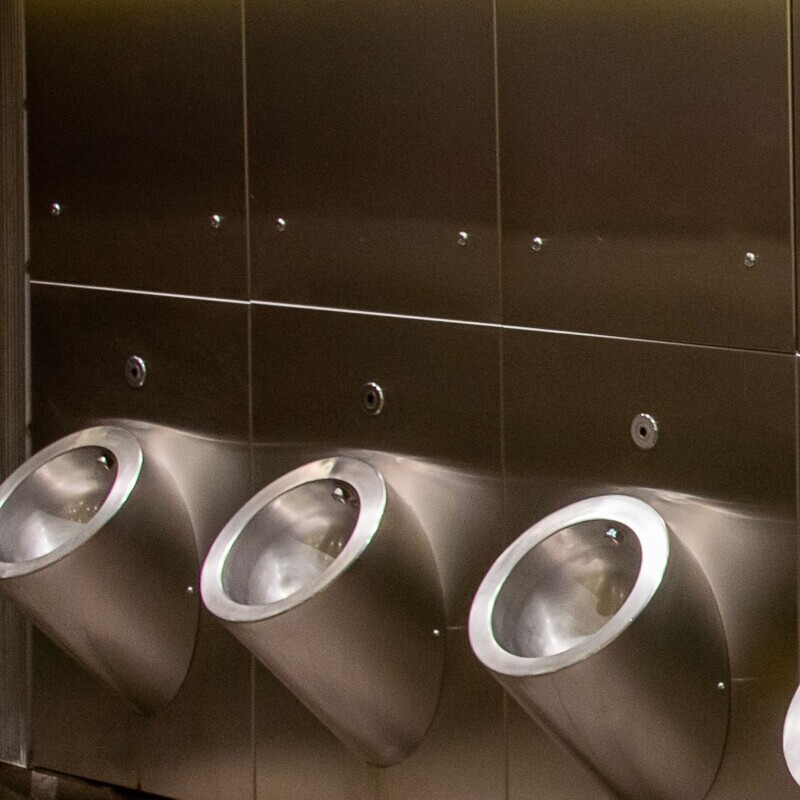
In any environment where fixtures and fittings may be exposed to water, corrosion resistance is essential. A stainless steel urinal trough, for instance, will last for decades without showing any signs of rust, provided it is cleaned regularly.
This is because stainless steel contains chromium, which forms a protective layer of chromium oxide on the stainless steel surface. This barrier makes stainless steel particularly resistant to oxidisation, which is what causes rust to form on metals.
What’s more, this thin protective layer can also help to “repair” any light scratches that appear in the metal surface due to natural wear and tear. This means scratches don’t become points for oxidisation of the metal and as a result reduces the chances of rust developing.
Stainless steel’s non-porous surface
The ability to prevent scratches from oxidising and even to repair small imperfections in the metal surface plays into stainless steel’s hygiene credentials, which are bolstered by its non-porous surface.
This simply means that it does not absorb any liquid that might fall on it, which helps ensure its durability and makes stainless steel incredibly easy to clean.
In public washrooms this is essential because they will be used by hundreds, or potentially thousands of people each day. The non-porous nature of the metal means that there is nowhere for bacteria, viruses or mould to grow.
As a result, with regular cleaning, stainless steel is a very hygienic choice for any fixtures in a public washroom.
The British Toilet Association recommends that any public washrooms are cleaned at least twice per day, ideally in periods between peak usage times. The organisation also stresses the importance of regular deep cleaning, usually carried out at six-weekly intervals.
Cleaning stainless steel washrooms is simple because they can be wiped down with a range of antibacterial sprays and cleaning agents. Due to the non-porous nature of the metal, the risk of causing damage with a cleaning substance is very low.
Stainless steel’s sleek appearance
Stainless steel looks sleek and gives a clinical edge to any public washroom. Because of all the qualities we’ve discussed so far, it typically looks clean, which can put users of public washrooms at ease.
In addition, the fuss-free appearance of stainless steel sinks, hand dryers and urinal troughs encourages efficiency of use in public washrooms. These are functional and valuable spaces, but they are not locations in which people are encouraged to linger.
Stainless steel also goes with all manner of other interior design choices, which means it can be incorporated into most public washrooms without feeling at odds with the broader aesthetic choices.
Stainless steel’s sustainability
A final reason to choose stainless steel fittings for your public washroom is that it is one of the most sustainable materials available. The steel is infinitely recyclable, which means that your fittings can be used for another purpose years in the future if needed.
What’s more, its longevity means that you will not need to replace fittings just a few years after they are installed. Instead you can look forward to getting decades of use out of your public washrooms.
Similarly, stainless steel products are usually recycled themselves. On average, today’s stainless steel items contain around 60 per cent recycled material. In European-produced stainless steel, the level of recycled content is closer to 95 per cent.
Related Posts