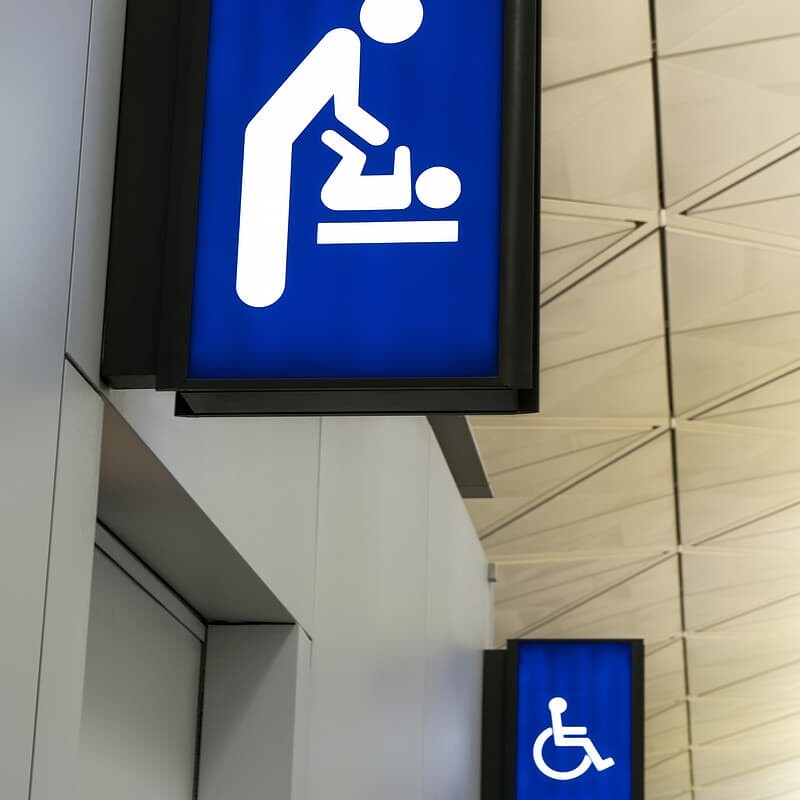
Every few years, the importance of public washrooms becomes a hot topic of discussion, particularly in local government, and over the last year, there has been a concerted effort to ensure that there is sufficient provision of publicly accessible toilet cubicles for people out and about.
There have been several endeavours, including the British Toilet Association’s ‘Legalise Loos’ campaign, to make it a statutory duty for national and local government bodies to provide sufficient public toilet provision.
At present, public washrooms are an optional provision that is the responsibility of local authorities, and when budgets start to shrink, public conveniences are often one of the first cuts that a local government will make, much to the justified chagrin of the local population.
There have been various proposals to help alleviate this and the “loo leash” that it creates and tightens, from underground rising public washrooms for use at night on busy high streets to requesting that local businesses allow people to use their washrooms without having to buy anything.
Another proposal, albeit one that is not without its fair share of controversy, is to implement more widespread charges for public toilets, based on the idea that people who want washrooms to be more widely available should pay for them.
It is a contentious issue, so in the interest of fairness, here is the context of the debate, why it could potentially help with washroom provision, but also the potential negative side effects.
Why Do Public Washrooms Matter?
Public washrooms are a fundamental pillar of accessibility, even beyond the provision of disabled and Changing Places toilets that are typically associated with accessible public buildings and civic spaces.
The ability to use a washroom is as vital to existing in public life as breathing or having access to clean water, and people can typically only exist in public spaces when they are not too far away from a publicly accessible washroom.
The first public toilets were initially privately owned and charged for use, which led to the euphemism “to spend a penny”.
Having public washrooms available matters as well to local businesses; in the absence of public facilities, more people will ask to use the toilet facilities of local businesses. This has recently caused controversy in Scarborough, according to the BBC.
In this particular case, opening up the washrooms of local businesses to the general public is a stopgap whilst more public washrooms are set up, but it highlights the scale of the problem in widely populated public areas.
As well as this, many people who need wider access to public washrooms have invisible conditions such as irritable bowel syndrome, colitis, Crohn’s disease or a stomach bug.
Other people need to use the washroom more often, including people on their period, people who are pregnant, young people, old people and people with conditions that affect the bladder or prostate.
What Are The Positives Of Charging For Public Washrooms?
The main logic for charging for public washrooms, outside of historical precedence, is that it solves the main issue that causes public facilities to be closed in the first place.
During a lengthy period of austerity in the UK, significant numbers of council-owned public toilets were closed due to a lack of resources to ensure they continued to be clean.
If people paid a nominal fee to use the facilities, that money would ultimately pay to keep them maintained, allow for them to be upgraded and ensure a high quality of service.
As well as this, they would be kept clean and be fixed far more quickly due to a financial motive to do so.
A luxury touch could also be added to make them a premium service that leaves a positive impression.
Finally, it gives users a stake in their quality; if you have paid to use a service, you are more likely to take care of it, and it minimises the chances of it falling into disrepair.
What Are The Downsides Of Charging For Public Washrooms?
Access to adequate washroom facilities is a human right, and it should not be limited to people who have the ability to pay. Whilst 50p is unlikely to be noticeable as a one-off payment, it adds up and can make public spaces just as inaccessible as a lack of public washrooms did.
As well as this, requiring payment means additional costs in implementing a payment system. As a lot of people do not carry around cash or small change, electronic payment systems need to be installed and maintained, which could potentially cost more than they would make.
Finally, there would need to be provisions for handling peak traffic, which would be slowed down by implementing payment systems.
Related Posts